
How to Use Chlorine Tablets in Your Pool (Step-by-Step Guide)
Chlorine tablets are one of the easiest ways to keep your pool clean and safe all season long. But "easy" doesn't mean "just toss one in and forget about it." Use them wrong and you risk chlorine imbalances, rising cyanuric acid (CYA) levels, or even equipment damage.
This guide walks you through exactly how to use chlorine tablets the right way — from calculating the correct dose to choosing the best delivery method for your setup.
What You'll Need Before You Start
Before adding any tablets to your pool, gather the following:
- A water test kit or test strips
- Chlorine tablets (3-inch for most pools; 1-inch for small above-ground pools or spas)
- A delivery device: floating dispenser, automatic chlorinator, or skimmer basket
- Gloves — always handle chlorine tablets with gloves
💡 Pro Tip: Profeliz 3-inch chlorine tablets come individually tube-packed in sets of 5, with gloves included in the bucket. No loose tablets rolling around, no messy hands.
Step-by-Step: How to Add Chlorine Tablets to Your Pool
Step 1: Test Your Water First
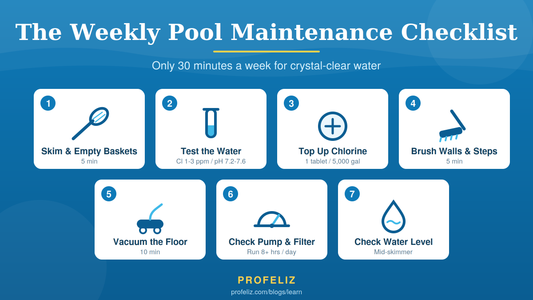
Before adding anything, test your current free chlorine level. The ideal range is 1–3 ppm. If your chlorine is already at 3 ppm or above, hold off on adding more tablets until levels drop.
Step 2: Calculate How Many Tablets You Need
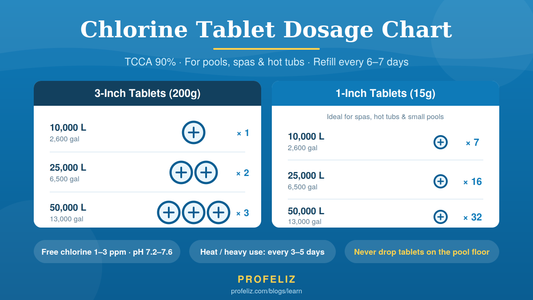
The standard rule: one 3-inch tablet per 5,000 gallons of pool water per week. Round your pool volume up to the nearest 5,000 gallons.
| Pool Size | Tablets Per Week |
|---|---|
| Up to 5,000 gallons | 1 tablet |
| 10,000 gallons | 2 tablets |
| 15,000 gallons | 3 tablets |
| 20,000 gallons | 4 tablets |
| 25,000+ gallons | 5+ tablets |
Step 3: Choose Your Delivery Method
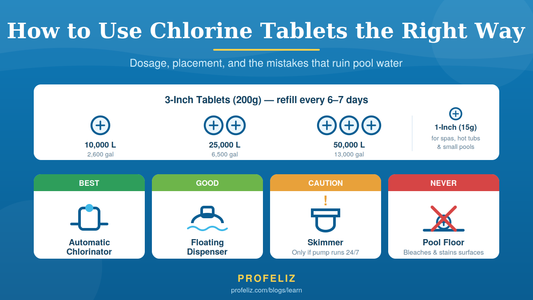
There are three common options — each has tradeoffs:
| Method | Best For | Notes |
|---|---|---|
| Floating dispenser | Most homeowners | Easy to use; remove during swimming |
| Automatic chlorinator | Larger pools, hands-off maintenance | Most consistent delivery; attaches to return line |
| Skimmer basket | Quick solution if no dispenser | Can corrode metal components; not ideal long-term |
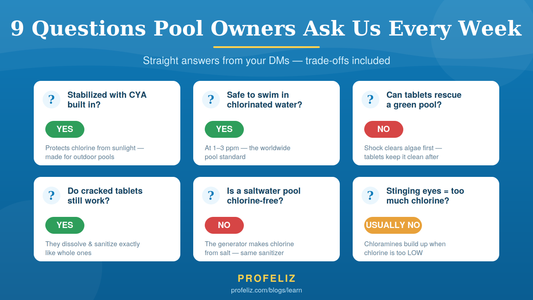
⚠️ Important: Never place tablets directly on the pool floor or steps. Concentrated chlorine sitting on surfaces can bleach or etch your pool liner or plaster.
Step 4: Place the Tablets and Run Your Pump
Add the correct number of tablets to your chosen dispenser. Run your pump for at least 8 hours a day to ensure the chlorine circulates evenly throughout the pool.
Step 5: Test Again After 24–48 Hours
Check free chlorine levels and adjust the dispenser flow rate if needed. Also monitor pH — trichlor tablets have a low pH (around 2.8–3.0) and will gradually lower your pool's pH over time. Keep pH in the 7.2–7.6 range.
Step 6: Repeat Weekly
Check your dispenser every 5–7 days. Replace dissolved tablets as needed and always test your water before adding more.
How to Calculate Your Pool's Volume
Not sure how many gallons your pool holds? Use these formulas:
- Rectangular pool: Length × Width × Average Depth × 7.5
- Round pool: Diameter × Diameter × Average Depth × 5.9
- Oval pool: Length × Width × Average Depth × 5.9
Example: A rectangular pool that's 16 ft × 32 ft × 5 ft average depth = 16 × 32 × 5 × 7.5 = 19,200 gallons. Round up to 20,000 → use 4 tablets per week.
Common Mistakes to Avoid
- Throwing tablets directly into the pool. Never put tablets in the water without a dispenser. Concentrated chlorine sitting on surfaces will bleach or damage your pool finish.
- Skipping water tests. Tablets keep working regardless of your current chlorine level. Without testing, it's easy to over-chlorinate — causing skin and eye irritation and wasting product.
- Ignoring CYA buildup. Every trichlor tablet adds cyanuric acid (CYA) to your water. Test CYA monthly. If it climbs above 80 ppm, partially drain and refill your pool. Ideal range: 30–50 ppm.
- Leaving the floater in during swimming. Floating dispensers release concentrated chlorine around them. Remove before swimmers get in.
- Using 3-inch tablets in a very small pool. For pools under 5,000 gallons, use 1-inch tablets instead. A 3-inch tablet can spike chlorine and CYA levels too quickly in a small volume of water.
Frequently Asked Questions
Can I put chlorine tablets directly in the pool?
No. Direct contact with pool surfaces causes bleaching and etching. Always use a floating dispenser, automatic chlorinator, or skimmer basket.
How often should I add chlorine tablets?
Check your dispenser every 5–7 days and replace tablets as they dissolve. Most 3-inch tablets last about one week in a standard pool.
Will chlorine tablets raise my CYA level?
Yes. Trichlor tablets contain cyanuric acid as a stabilizer. Over the course of a season, CYA will gradually accumulate. Test monthly and dilute with fresh water if CYA exceeds 80 ppm.
What if my chlorine level is too high?
Stop adding tablets and let the pump run. Chlorine naturally breaks down over time — especially in direct sunlight. Do not swim until levels drop back to 1–3 ppm.
Can I use Profeliz tablets in an above-ground pool?
Yes — Profeliz 3-inch chlorine tablets are compatible with all pool types, including above-ground and in-ground pools. For very small above-ground pools (under 5,000 gallons), consider the 1-inch tablets for more precise dosing.
Ready to Get Started?
Profeliz 3-inch chlorine tablets are available in 4, 20, 40, and 80 lb sizes — so whether you're maintaining a small backyard pool or stocking up for the full season, there's a size that fits.
Tags:
Previous
Pool Care 101: How to Maintain a Pool for Beginners
Next
Trichlor vs. Dichlor: Which Chlorine Tablet Is Right for Your Pool?