
How to Open Your Pool for Summer: A Complete Checklist
After a long winter, there's nothing better than getting your pool ready for the first swim of the season. But if you rush the opening process — or skip a few steps — you could be dealing with green water, equipment issues, or unbalanced chemistry before anyone even gets in.
This guide walks you through the full pool opening process in the right order, with a checklist you can follow from start to finish.
When Should You Open Your Pool?
The right time to open your pool depends on your local climate, not the calendar.
The general rule: open your pool when your overnight water temperature consistently stays above 60°F (15°C). Below that threshold, algae growth is minimal and you can afford to wait. But once temperatures start climbing, algae can establish quickly — especially if your pool has been covered all winter.
Opening too late is a common mistake. A pool that's been sitting closed in warm weather is much harder (and more expensive) to recover than one that was opened on time.
💡 Rule of thumb: If it's warm enough to want to swim, it's warm enough to open the pool.
What You'll Need
Equipment
- Pool cover pump (to remove standing water before pulling the cover)
- Garden hose
- Pool brush and vacuum
- Skimmer net
- Wrench and screwdriver for equipment reconnection
Chemicals
- Water test kit or test strips (for chlorine, pH, alkalinity, calcium hardness, CYA)
- pH increaser (sodium carbonate) and pH decreaser (sodium bisulfate)
- Alkalinity increaser (sodium bicarbonate)
- Calcium hardness increaser (if needed)
- Pool shock (cal-hypo or liquid chlorine)
- Chlorine tablets for ongoing maintenance
- Algaecide (optional, for prevention)
Step-by-Step: How to Open Your Pool
Step 1: Remove and Clean the Winter Cover
Start by pumping off any standing water on top of the cover, then carefully remove it with a helper to avoid dumping debris into the pool. Lay it flat on your lawn or driveway, rinse it clean, let it dry, and fold it for storage. A clean, dry cover stored properly will last years longer than one folded wet.
Step 2: Reconnect Equipment
Reinstall any equipment you removed for winter:
- Reattach return jets, skimmer baskets, and drain plugs
- Reconnect the pump, filter, and heater
- Remove any winterizing plugs from return lines
- Check all O-rings and gaskets — replace any that look cracked or brittle
Don't run the pump yet. Make sure everything is physically reconnected and tight first.
Step 3: Fill the Pool to Normal Water Level
Water evaporates over winter, and water level also drops when equipment is blown out. Use your garden hose to bring the water up to the middle of the skimmer opening — this is the operating level the pump and skimmer are designed to work at.
Step 4: Start Up the Pump and Filter
Turn on the pump and let it run. Check for leaks around all connections — even a small drip can become a big problem during the season. Let the system run for at least a full cycle (8–12 hours) before moving on to chemistry.
If you have a sand or DE filter: backwash before the season starts to flush out debris that settled over winter.
Step 5: Test Your Water
Before adding any chemicals, test your baseline water chemistry:
| Parameter | Ideal Range |
|---|---|
| Free Chlorine | 1–3 ppm |
| pH | 7.2–7.6 |
| Total Alkalinity | 80–120 ppm |
| Calcium Hardness | 200–400 ppm |
| Cyanuric Acid (CYA) | 30–50 ppm |
Write down your results. This tells you exactly what the water needs — and in what order to add chemicals.
Step 6: Balance Your Water Chemistry (In This Order)
Order matters. Adding chemicals in the wrong sequence reduces their effectiveness and can cause cloudiness.
- Total Alkalinity first — TA acts as a buffer for pH. Adjust this before touching pH.
- pH second — Once TA is stable, bring pH into the 7.2–7.6 range.
- Calcium Hardness third — Low calcium causes the water to pull minerals from your pool surfaces (etching). High calcium causes scaling.
- CYA last — Add stabilizer only after the other parameters are balanced.
Wait at least a few hours (ideally overnight) between adjustments and retest before moving to the next step.
Step 7: Shock the Pool
Even if your water looks clear, shock treatment is essential at opening. Over winter, organic contaminants — algae spores, bacteria, leaves, debris — accumulate and bind up your chlorine. Shocking breaks through this and resets the water.
Use a cal-hypo shock or liquid chlorine at the opening dose (typically 1 lb of shock per 10,000 gallons, or follow product label). Add shock in the evening, run the pump overnight, and retest in the morning.
⚠️ Do not swim until free chlorine drops back to 3 ppm or below after shocking.
Step 8: Start Your Chlorine Tablet Routine
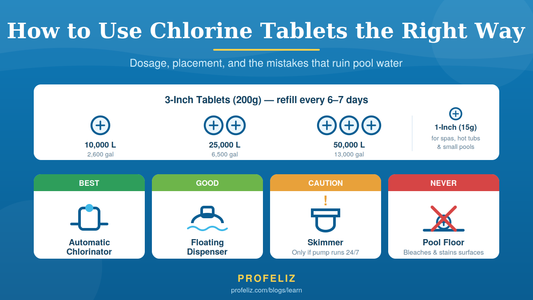
Once the shock has done its job and chlorine is back in range, switch to your regular maintenance routine with chlorine tablets. Load up your floating dispenser or automatic chlorinator and begin your weekly schedule.
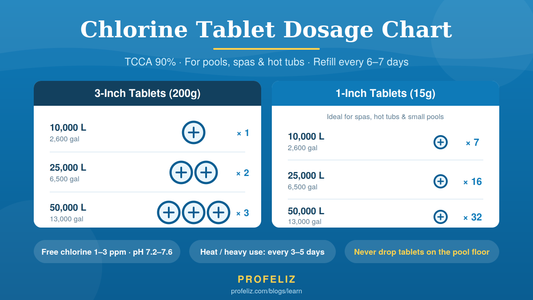
For dosing guidance, see: How to Use Chlorine Tablets in Your Pool →
Step 9: Brush and Vacuum
With the chemistry sorted, give the pool a thorough brushing — walls, floor, steps, and any corners where algae likes to hide. Vacuum up any debris that settled over winter. Run the filter for another full cycle after vacuuming to clear the water.
Step 10: Final Check
Before declaring the pool open:
- Retest water chemistry and confirm all parameters are in range
- Check that all safety equipment is in place (drain covers, fencing, life rings)
- Inspect and test any pool lights
- Make sure the pump timer is programmed for 8+ hours per day
Quick-Reference Opening Checklist
- Remove and clean winter cover
- Reconnect all equipment and fittings
- Fill pool to operating water level
- Start pump, check for leaks
- Backwash filter
- Test baseline water chemistry
- Adjust Total Alkalinity
- Adjust pH
- Adjust Calcium Hardness
- Adjust CYA if needed
- Shock the pool (evening)
- Run pump overnight
- Retest chemistry in the morning
- Load chlorine tablets into dispenser
- Brush and vacuum
- Final safety check
Common Pool Opening Mistakes
- Skipping the shock. Even if the water looks fine, it almost certainly has accumulated contaminants over winter. Shocking isn't optional — it's the reset your pool needs.
- Adding chemicals all at once. Always add one chemical at a time, wait for it to circulate, and retest before adding the next. Adding everything at once can cause cloudiness, scale, or chemical interactions.
- Running the pump before reconnecting everything. Dry-running the pump — even briefly — can damage the motor seals. Make sure all connections are complete before starting up.
- Opening too late in warm weather. Every week you wait after temperatures rise is a week algae has to establish itself. An algae bloom that's been sitting for weeks is significantly harder to clear than one that's just starting.
- Forgetting to check CYA. If you added stabilizer last season and haven't drained any water over winter, your CYA may already be elevated. Test before adding more. High CYA reduces chlorine effectiveness — for a deep dive, see our guide: What Is CYA and Why Does It Matter?
Frequently Asked Questions
How long does it take to open a pool? The physical setup — removing the cover, reconnecting equipment, filling the water — usually takes 2–4 hours. Balancing the chemistry properly takes 24–48 hours, including shock treatment and retesting. Plan for a full weekend if you want everything dialed in before the first swim.
Do I need to shock my pool at opening even if the water looks clear? Yes. Clear water doesn't mean clean water. Chloramines, algae spores, and bacteria can all be present without visible signs. Shock treatment at opening is standard practice regardless of how the water looks.
What order should I add pool opening chemicals? Always go: Total Alkalinity → pH → Calcium Hardness → CYA → Shock. Adding in this order ensures each chemical works correctly without interference from the others.
Can I swim right after opening the pool? Not immediately. After shocking, wait until free chlorine drops back to 3 ppm or below before swimming. Test the water to confirm — don't guess based on timing alone.
How much shock do I need to open my pool? A standard opening dose is 1 lb of cal-hypo shock per 10,000 gallons of water. If the water is visibly green or cloudy, double the dose and repeat the next day if needed.
Ready for the Season?
Once your pool is open and balanced, chlorine tablets take care of the week-to-week maintenance. Profeliz 3-inch tablets are available in 4, 20, 40, and 80 lb sizes — stock up at the start of the season so you're not scrambling mid-summer.
Tags:
Previous
Trichlor vs. Dichlor: Which Chlorine Tablet Is Right for Your Pool?
Next
What Is CYA (Cyanuric Acid) in a Pool — and Why Should You Care?