
What Is CYA (Cyanuric Acid) in a Pool — and Why Should You Care?
If you've ever had a pool service tech mention "stabilizer levels" or found your chlorine mysteriously disappearing faster than it should, there's a good chance CYA is part of the conversation. Cyanuric acid is one of the most misunderstood aspects of pool chemistry — and one of the most important to get right.
Too little CYA and your chlorine burns off in hours. Too much and your chlorine stops working entirely, even when the reading looks fine.
Here's everything you need to know.
What Is Cyanuric Acid (CYA)?
Cyanuric acid — also called pool stabilizer or pool conditioner — is a chemical compound that protects chlorine from being broken down by UV sunlight.
Without CYA, direct sunlight can destroy up to 50% of your pool's free chlorine in just 30–45 minutes. In a sunny backyard, an untreated pool could lose its entire chlorine supply within a couple of hours, leaving the water completely unsanitized.
CYA works by forming a temporary bond with chlorine molecules, effectively shielding them from UV degradation. The chlorine is still active and still sanitizes the water — it's just protected long enough to actually do its job.
Where Does CYA Come From?
CYA enters your pool in two ways:
1. Added directly as a standalone product Cyanuric acid is sold as a dry stabilizer or liquid conditioner. Pool owners — especially those using unstabilized chlorine like liquid chlorine or cal-hypo — add it at the start of the season to bring CYA up to the target range.
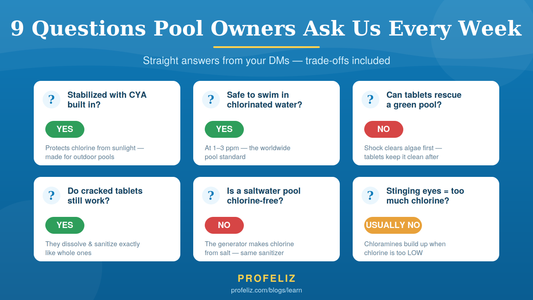
2. Built into stabilized chlorine tablets This is the more common source for most homeowners. Both Trichlor and Dichlor chlorine tablets already contain cyanuric acid as part of their formula. Every time you add a tablet to your pool, you're adding a small amount of CYA along with the chlorine.
This is actually a feature, not a bug — it's what makes stabilized chlorine tablets so convenient for outdoor pools. But it also means CYA levels will gradually rise throughout the swim season, which is why monitoring matters.
For a deeper look at stabilized vs. unstabilized chlorine, see: Trichlor vs. Dichlor: Which Chlorine Tablet Is Right for Your Pool? →
What Are the Ideal CYA Levels?
| Pool Type | Ideal CYA Range |
|---|---|
| Outdoor pool (using chlorine tablets) | 30–50 ppm |
| Outdoor pool (using unstabilized chlorine) | 30–50 ppm |
| Saltwater pool | 70–80 ppm |
| Indoor pool | 0 ppm (no UV exposure, no stabilizer needed) |
| Hot tub / spa | 0 ppm (small volume, high turnover) |
For most outdoor pools, 30–50 ppm is the sweet spot. At this level, CYA provides meaningful UV protection without interfering with chlorine's sanitizing ability.
What Happens If CYA Is Too Low?
Below 20 ppm, your chlorine has little to no UV protection. In a sunny outdoor pool, you'll burn through chlorine far faster than normal — which means higher chemical costs, more frequent dosing, and stretches where the water is under-sanitized between additions.
If your CYA is at zero (like at the start of the season or after a significant water change), add a standalone cyanuric acid product to bring it up before relying on tablets alone.
What Happens If CYA Is Too High?
This is where most pool owners run into problems.
High CYA doesn't just protect chlorine — it also reduces its effectiveness. At elevated CYA levels, the bond between CYA and chlorine becomes too strong, making the chlorine less available to actually kill bacteria and algae. This is called chlorine lock (technically "chlorine demand" or "high CYA interference").
The result: your test strip shows 3 ppm of chlorine, but the water isn't being properly sanitized. You might notice persistent algae growth, cloudy water, or eye irritation despite chlorine readings that look normal.
| CYA Level | Effect on Chlorine |
|---|---|
| 0–20 ppm | Chlorine works well but degrades rapidly in sunlight |
| 30–50 ppm | Ideal balance — good UV protection, full effectiveness |
| 60–80 ppm | Chlorine effectiveness begins to decline |
| 80–100 ppm | Significant reduction in chlorine activity |
| 100+ ppm | Chlorine largely ineffective — water unsafe despite readings |
⚠️ Important: If your CYA is above 80 ppm, adding more chlorine won't solve the problem. You need to lower the CYA first.
How to Test CYA Levels
Standard test strips often don't measure CYA accurately. For a reliable reading, use one of the following:
- Turbidity test kit — The most common method. You add pool water to a reagent and look through the tube until a black dot disappears. The level at which the dot disappears indicates your CYA concentration.
- Liquid reagent test kit — More accurate than strips; available at most pool supply stores.
- Professional water test — Most pool supply stores offer free water testing. If you want a precise baseline at the start of the season, this is the most reliable option.
Test CYA once a month during swim season, and always test at pool opening before adding any stabilizer.
How to Lower CYA If It's Too High
Here's the hard truth: there is no chemical that removes CYA from pool water. The only reliable way to lower CYA is to dilute it by draining a portion of your pool and refilling with fresh water.
How much water to drain:
Use this formula to estimate how much to drain:
Drain fraction = 1 − (Target CYA ÷ Current CYA)
Example: Current CYA is 100 ppm, target is 40 ppm. Drain fraction = 1 − (40 ÷ 100) = 0.60 → drain and replace 60% of your pool water.
This sounds like a lot, but partial drains are routine maintenance for pools that have been running on Trichlor tablets for a full season without any water changes.
Practical tips:
- Drain to the point where the skimmer starts pulling air, then refill
- For pools in drought-prone areas, check local water restrictions before draining
- After refilling, retest and rebalance all chemistry — pH, alkalinity, calcium hardness, and chlorine — before swimming
How to Prevent CYA From Getting Too High
The easiest way to manage CYA long-term is to plan for gradual accumulation:
- Test monthly — Don't wait until you have a problem to check CYA levels
- Do a partial water change each season — Draining and replacing 20–30% of your pool water at the start or end of the season resets CYA naturally
- Consider switching to unstabilized chlorine periodically — If CYA is climbing toward 70 ppm, temporarily switch to liquid chlorine or cal-hypo shock (which don't add CYA) while you dilute the pool down
- Don't over-stabilize at pool opening — If you're adding standalone CYA at the start of the season, test first. Residual CYA from last year may still be present even after winter
Frequently Asked Questions
Do chlorine tablets raise CYA? Yes. Both Trichlor and Dichlor chlorine tablets contain cyanuric acid as a built-in stabilizer. Every tablet you add raises your CYA level slightly. Over a full swim season of regular use, CYA will accumulate — which is why monthly testing is essential.
What is the maximum safe CYA level for a pool? Most pool professionals recommend keeping CYA below 80 ppm. Above that threshold, chlorine effectiveness drops significantly. At 100 ppm or above, chlorine becomes largely ineffective at sanitizing the water, even if test readings appear normal.
Can I swim if CYA is too high? The water may look fine, but high CYA reduces chlorine's ability to kill bacteria and algae — meaning the water may not be properly sanitized even if your chlorine reading is in range. It's best to lower CYA before regular swimming resumes.
Is there a chemical that removes CYA from pool water? No. The only way to lower CYA is to dilute it by draining part of the pool and refilling with fresh water. There are no products that chemically neutralize or remove CYA once it's in the water.
Does CYA affect pH or alkalinity? Not significantly in normal ranges. CYA is a weak acid, so very high levels can have a minor effect on pH, but this is rarely the primary concern. Focus on managing CYA levels directly rather than trying to compensate through pH adjustments.
How do I know if chlorine lock is causing my pool problems? Signs include: algae growth despite normal chlorine readings, persistent cloudiness, or chlorine that disappears unusually fast. If your chlorine is testing at 1–3 ppm but the water still looks or smells off, test your CYA — if it's above 80 ppm, that's likely the cause.
The Bottom Line
CYA is essential for outdoor pool maintenance — it's what makes weekly chlorine tablets practical instead of a daily chore. But it needs to be managed, not ignored. Test monthly, keep it between 30–50 ppm, and do a partial water change when it starts climbing.
Get the foundation right and your chlorine will do exactly what it's supposed to: keep your pool clean, clear, and safe all season long.
For your week-to-week chlorine routine, see: How to Use Chlorine Tablets in Your Pool →
Tags:
Previous
How to Open Your Pool for Summer: A Complete Checklist
Next
How to Clear a Green Pool Fast (Without Draining It)