
How to Clear a Green Pool Fast (Without Draining It)
You walk outside, look at your pool, and it's green. Maybe it happened overnight after a storm. Maybe you came back from vacation to find it. Either way, the instinct is to drain it and start over — but that's almost never necessary, and in some cases it can actually damage your pool.
The good news: most green pools can be cleared in 3–5 days with the right approach. Here's exactly what to do.
Why Did Your Pool Turn Green?
Green pool water is almost always caused by algae. Algae spores are naturally present in the environment and constantly entering your pool through rain, wind, and swimmers. Under normal conditions, your chlorine kills them before they can establish. When chlorine drops too low — or CYA is too high and making chlorine ineffective — algae takes hold fast.
Common triggers:
- Chlorine ran out — skipped a week of tablets, or the floater ran empty
- High CYA reducing chlorine effectiveness — your chlorine reads fine but can't actually kill anything
- Heavy rain — dilutes chlorine and introduces algae spores
- Warm weather spike — algae grows exponentially faster above 80°F
- Poor circulation — dead spots in the pool where water isn't moving
The severity determines how aggressive your treatment needs to be:
| Water Color | Algae Severity | Treatment Time |
|---|---|---|
| Light green / teal | Mild | 1–2 days |
| Medium green | Moderate | 2–3 days |
| Dark green, murky | Severe | 3–5 days |
| Black-green, can't see bottom | Very severe | 5–7 days |
What You'll Need
- Water test kit (chlorine, pH, CYA)
- Pool shock (cal-hypo, at least 1 lb per 10,000 gallons — likely more)
- pH decreaser (sodium bisulfate) if pH is above 7.6
- Algaecide (optional but speeds up severe cases)
- Pool brush — stiff bristle for concrete, nylon for vinyl/fiberglass
- Skimmer net
- Pool vacuum or automatic cleaner
Step-by-Step: How to Clear a Green Pool
Step 1: Test Your Water
Before adding anything, test your current levels — especially pH and CYA.
- pH needs to be between 7.2–7.6 for shock to work effectively. Above 7.8, shock loses most of its potency. Adjust pH first if it's out of range.
- CYA — if CYA is above 80 ppm, your chlorine won't work regardless of how much you add. This is critical. If CYA is the problem, you'll need to partially drain and dilute before treating. See: What Is CYA and Why Does It Matter? →
Step 2: Brush the Entire Pool
This step gets skipped constantly, and it's one of the most important.
Algae clings to pool surfaces — walls, floor, steps, corners. Brushing breaks up the algae colonies and exposes them to the shock treatment. Without brushing, you can shock repeatedly and never fully clear the pool because the algae has a protective layer.
Brush everything. Scrub corners and steps especially hard. You'll likely see green clouds billowing off the walls — that's exactly what you want.
Step 3: Shock the Pool — and Then Shock Again
For a green pool, a standard maintenance dose of chlorine won't cut it. You need to superchlorinate — raise free chlorine to 10–30 ppm depending on severity.
Shock dosage by severity:
| Water Color | Shock Dose |
|---|---|
| Light green | 2 lbs cal-hypo per 10,000 gallons |
| Medium green | 3 lbs per 10,000 gallons |
| Dark green | 4+ lbs per 10,000 gallons |
Add shock in the evening to prevent UV from degrading it before it can work. Broadcast it across the pool while walking around the perimeter — don't dump it all in one spot.
Run your pump continuously (24 hours if possible) while treating.
⚠️ Do not swim during treatment. Wait until free chlorine drops back to 3 ppm or below.
Step 4: Run the Filter Continuously
Your filter is doing the heavy lifting here — it's physically removing dead algae from the water. Run it 24/7 until the water clears.
Clean or backwash your filter every 24 hours during treatment. A clogged filter can't clear the water no matter how much shock you add. If your pressure gauge reads 8–10 psi above normal, backwash immediately.
For cartridge filters: remove and rinse with a hose every day during treatment.
Step 5: Retest and Reshock if Needed
After 12–24 hours, retest your chlorine level. If it's dropped back to near zero, the algae is still consuming it — shock again at the same dose.
The pool is winning the battle when:
- Water color shifts from green to grey/cloudy white (dead algae in suspension)
- Chlorine levels hold above 3 ppm for several hours
- You can start to see the bottom of the shallow end
Grey/cloudy water after shocking is normal and a good sign — it means the algae is dead and just needs to be filtered out.
Step 6: Vacuum and Clean Up
Once the water starts clearing, vacuum the pool to remove dead algae from the floor. If your pool has a lot of debris, vacuum to waste (bypassing the filter) to avoid clogging it — check your filter's settings for a "waste" or "drain" option.
Continue running the filter and backwashing daily until the water is fully clear.
Step 7: Rebalance and Resume Maintenance
Once the water is clear, do a full water test and rebalance chemistry:
- pH: 7.2–7.6
- Total Alkalinity: 80–120 ppm
- CYA: 30–50 ppm
- Free Chlorine: 1–3 ppm
Then load up your chlorine tablets and get back on your regular maintenance schedule to prevent a recurrence.
How Long Will It Take?
| Severity | Expected Clearing Time |
|---|---|
| Light green | 1–2 days |
| Medium green | 2–3 days |
| Dark green | 3–5 days |
| Very severe (black-green) | 5–7 days |
These timelines assume continuous pump operation, daily filter cleaning, and reshocking as needed. Cut corners on any of those and it'll take longer.
How to Prevent It From Happening Again
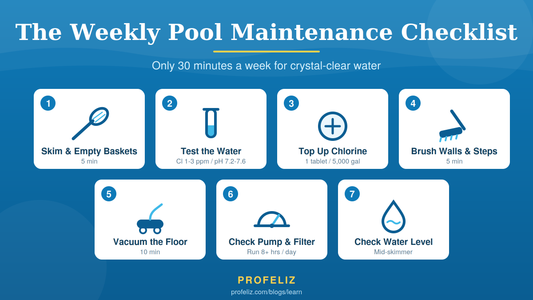
- Never let your chlorine run out. Check your dispenser every 5–7 days and restock before it's empty.
- Keep CYA in range. High CYA makes your chlorine ineffective — test monthly.
- Run your pump at least 8 hours a day. Poor circulation creates dead zones where algae establishes.
- Shock after heavy rain or heavy bather load. Both events consume chlorine rapidly.
- Brush your pool walls weekly. Regular brushing disrupts algae before it can bloom.
Frequently Asked Questions
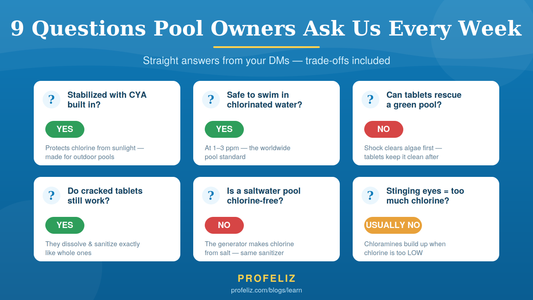
Can I clear a green pool without draining it? Yes — draining is almost never necessary for algae treatment. Super-chlorinating (shocking) combined with continuous filtration clears most green pools within 3–5 days. Draining is only warranted in extreme cases where CYA is severely elevated and can't be managed through dilution.
Why is my pool still green after shocking? Most likely one of three reasons: CYA is too high and neutralizing the shock, pH is above 7.6 making the shock ineffective, or you didn't use enough shock for the severity of the algae bloom. Test CYA and pH first, then re-shock at a higher dose.
My pool turned green overnight — is that normal? It can happen surprisingly fast, especially in warm weather. Algae growth doubles every few hours above 80°F, so a pool that's slightly low on chlorine on a hot evening can look green by morning. It's normal — just treat it promptly.
Do I need algaecide to clear a green pool? Not always. Shock + filtration handles most green pool situations. Algaecide can speed up the process and is useful as a preventative after clearing, but it's not a substitute for shock — it won't clear an established algae bloom on its own.
How much shock do I need for a green pool? Plan on at least 2–4 lbs of cal-hypo per 10,000 gallons depending on severity, and be prepared to reshock the next day if chlorine levels drop back to zero overnight. Undershooting is the most common mistake.
Get Your Pool Back on Track
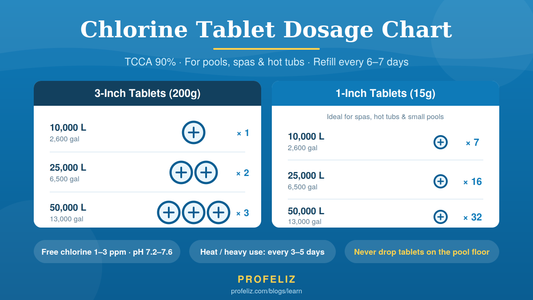
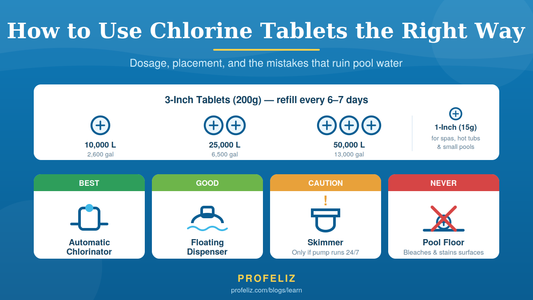
Once your pool is clear, the key is staying ahead of it with a consistent chlorine routine. Profeliz 3-inch chlorine tablets are a simple, reliable way to maintain sanitizer levels week after week — no measuring, no daily dosing.
For your regular maintenance routine: How to Use Chlorine Tablets in Your Pool →
Tags:
Previous
What Is CYA (Cyanuric Acid) in a Pool — and Why Should You Care?
Next
Why Is My Pool Water Cloudy? 7 Causes and How to Fix Each One