
Why Is My Pool Water Cloudy? 7 Causes and How to Fix Each One
Cloudy pool water is one of the most common complaints from pool owners — and one of the most misdiagnosed. The instinct is to dump in more chlorine and hope for the best, but cloudy water has multiple possible causes, and the fix depends entirely on which one you're dealing with.
Add the wrong chemical to the wrong problem and you could make it worse.
Here's a breakdown of the seven most common causes of cloudy pool water, how to identify each one, and exactly what to do about it.
Quick Diagnosis: What Does Your Cloudy Water Look Like?
Before jumping to solutions, narrow down the cause:
| Appearance | Likely Cause |
|---|---|
| Milky white / hazy throughout | Low chlorine, pH imbalance, or high calcium |
| Cloudy with green tint | Early algae bloom |
| Cloudy after shocking | Dead algae in suspension (normal — filter it out) |
| Cloudy near returns / jets | Poor circulation or filter issue |
| Cloudy after heavy rain | Diluted chemistry or introduced contaminants |
| Cloudy despite "normal" readings | High CYA causing chlorine lock |
Cause 1: Low or Ineffective Chlorine
The most common cause. When free chlorine drops below 1 ppm, bacteria and organic particles accumulate faster than they can be oxidized, and the water turns hazy.
How to confirm: Test free chlorine. If it's below 1 ppm — or at zero — this is your problem.
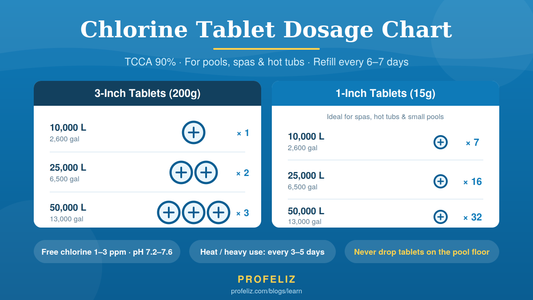
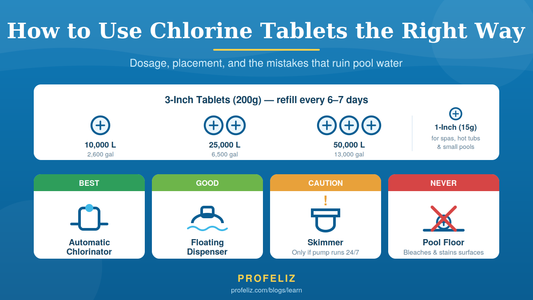
Fix: Shock the pool to superchlorinate, then resume your regular chlorine tablet routine. Run the pump for 24 hours after shocking and retest. For ongoing maintenance, chlorine tablets in a floater or automatic chlorinator keep levels consistent between weekly checks.
Cause 2: pH Out of Range
pH affects almost everything in your pool — including how effective your chlorine is and how dissolved particles behave in the water. When pH climbs above 7.8, calcium and other minerals start to precipitate out of solution, causing a white haze. High pH also makes chlorine significantly less effective.
How to confirm: Test pH. Above 7.8 and you've found your culprit.
Fix:
- pH too high (above 7.6): Add pH decreaser (sodium bisulfate or muriatic acid). Add in small doses, circulate for 30 minutes, and retest before adding more.
- pH too low (below 7.2): Add pH increaser (sodium carbonate). Low pH causes eye irritation and corrodes pool equipment over time.
Target range: 7.2–7.6.
Cause 3: High Total Alkalinity
Total alkalinity (TA) acts as a pH buffer — it keeps pH from swinging wildly. But when TA is too high (above 120 ppm), it makes pH stubbornly resistant to adjustment and can cause the water to take on a milky appearance.
How to confirm: Test TA. Above 120 ppm alongside hazy water points to this cause.
Fix: Add pH decreaser (muriatic acid or dry acid) to bring TA down. Add it in the deep end with the pump running, aerate the water afterward to help stabilize pH. This is a gradual process — expect to make adjustments over several days.
Target range: 80–120 ppm.
Cause 4: High Calcium Hardness
Calcium hardness refers to the concentration of dissolved calcium in your water. When calcium gets too high (above 400 ppm), it starts to precipitate out — forming a fine white haze, scale on surfaces, and deposits on equipment.
How to confirm: Test calcium hardness. Above 400 ppm with white haze is a strong indicator.
Fix: Unfortunately, like CYA, there's no chemical that removes excess calcium. The solution is dilution — partially drain the pool and refill with fresh water. If you're on a water source with naturally hard water, this is an ongoing management issue.
Target range: 200–400 ppm.
Cause 5: Poor Filtration or Circulation
Your filter removes suspended particles from the water. If the filter is dirty, undersized, or not running long enough, those particles stay in suspension and the water stays cloudy — regardless of chemistry.
How to confirm: Check your filter pressure gauge. If it reads 8–10 psi above normal baseline, the filter is dirty. Also check how many hours per day the pump is running.
Fix:
- Sand/DE filter: Backwash until the return water runs clear
- Cartridge filter: Remove and rinse thoroughly with a hose; replace if damaged
- Run time: Pump should run at least 8 hours per day — ideally 10–12 in hot weather or after heavy use
- Dead spots: Adjust return jet angles to improve circulation throughout the pool
Cause 6: High CYA (Chlorine Lock)
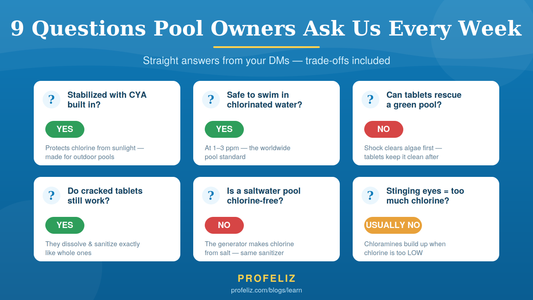
This one catches a lot of pool owners off guard. When CYA climbs above 80 ppm, it binds so strongly to chlorine that the chlorine can no longer effectively oxidize particles or kill pathogens. The result: cloudy water despite chlorine readings that look completely normal.
How to confirm: Test CYA. If it's above 80 ppm and your chlorine appears to be in range but the water is still cloudy, this is likely the cause.
Fix: Partial drain and refill to dilute CYA back into the 30–50 ppm range. There's no shortcut here — no chemical removes CYA from water. For a full explanation, see: What Is CYA and Why Does It Matter? →
Cause 7: Environmental Contamination
Heavy rain, wind, and heavy bather loads all introduce contaminants that consume chlorine and cloud the water:
- Rain: Dilutes chemistry, introduces organic matter and algae spores, and can drop pH
- Wind: Blows in dust, pollen, and debris
- Heavy bather load: Sunscreen, body oils, and sweat consume chlorine rapidly
How to confirm: Cloudiness appeared shortly after a rainstorm, a pool party, or a stretch of windy weather.
Fix: Shock the pool the evening after the event, run the pump overnight, and retest in the morning. For recurring issues after rain, consider a weekly shock habit during summer rather than reacting after the fact.
Step-by-Step: How to Clear Cloudy Pool Water
- Test your water — chlorine, pH, TA, calcium hardness, and CYA. Don't skip CYA.
- Fix chemistry in order — TA first, then pH, then address CYA if elevated
- Shock if chlorine is low — use cal-hypo shock at 1–2 lbs per 10,000 gallons in the evening
- Clean or backwash the filter — a dirty filter can't clear cloudy water no matter what you add
- Run the pump 24 hours — continuous circulation accelerates clearing
- Use a pool clarifier if needed — clarifiers cause fine particles to clump together so the filter can catch them; useful for persistent haziness after chemistry is balanced
- Retest after 24–48 hours — confirm levels before resuming normal schedule
Frequently Asked Questions
How long does it take for cloudy pool water to clear? With the right fix applied, most cases of cloudy water clear within 24–48 hours. Filter issues or chemistry imbalances that have been building for a while can take 3–5 days of continuous pump operation to fully resolve.
Can I swim in cloudy pool water? It depends on the cause. Cloudy water from dead algae post-shock is generally safe once chlorine drops to 3 ppm. Cloudiness caused by low chlorine, high CYA, or bacterial buildup means the water may not be properly sanitized — avoid swimming until chemistry is corrected and the water is clear.
Why is my pool cloudy after I shocked it? This is usually a good sign. Dead algae and oxidized particles are suspended in the water after shocking — the cloudiness is them, not a new problem. Run the filter continuously and backwash daily. The water should clear within 24–48 hours as the filter catches the debris.
My chlorine tests normal but the water is still cloudy — why? The most likely cause is high CYA (above 80 ppm) causing chlorine lock, where chlorine reads correctly but can't actually sanitize. Test your CYA — if it's elevated, dilution is the fix. A dirty filter is the other common culprit.
Does pool clarifier work for cloudy water? Yes, but only when chemistry is already balanced. Clarifier is a coagulant — it clumps together fine particles so your filter can remove them. It doesn't fix chemistry problems. Use it as the final step after balancing water and cleaning the filter, not as a first response.
Keep Your Pool Clear All Season
Most cloudy pool problems trace back to the same root cause: inconsistent chlorine maintenance. A steady chlorine routine — testing weekly, keeping your dispenser stocked, and staying on top of CYA — prevents the conditions that lead to cloudiness in the first place.
For your regular maintenance routine: How to Use Chlorine Tablets in Your Pool →
Tags:
Previous
How to Clear a Green Pool Fast (Without Draining It)
Next
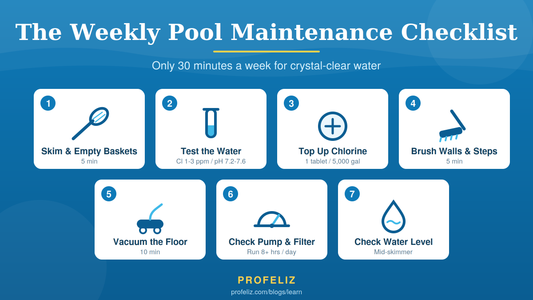
The Ultimate Weekly Pool Maintenance Checklist (Only 30 Minutes a Week)