
The Ultimate Weekly Pool Maintenance Checklist (Only 30 Minutes a Week)
A sparkling pool doesn't happen by accident — but it doesn't require hours of work, either. Most green water, cloudy water, and algae problems we hear about start the same way: a week or two of skipped maintenance during the busy summer months.
The good news? A consistent 30-minute weekly routine prevents almost every common pool problem before it starts. No emergency shock treatments, no draining, no last-minute scrambles before a pool party.
Here's the exact checklist to follow, in order.
1. Skim the Surface and Empty the Baskets (5 minutes)
Start with the easy stuff. Use a leaf net to skim floating debris — leaves, bugs, grass clippings — off the surface. Then empty your skimmer baskets and the pump strainer basket.
Why this matters: organic debris is algae food. Leaves that sink and start decomposing consume your chlorine and release phosphates, which is exactly what algae needs to bloom. Five minutes of skimming saves you a green pool later.
Pro tip: If you're surrounded by trees, skim twice a week during fall or after storms. It's faster to skim often than to vacuum a debris-covered floor.
2. Test Your Water (5 minutes)
This is the single most important step on the list. Test your water once a week — twice during heat waves or heavy swim weekends. You're looking for four numbers:
- Free chlorine: 1–3 ppm. This is your sanitizer. Below 1 ppm, bacteria and algae start multiplying. Above 5 ppm, swimmers may notice eye and skin irritation.
- pH: 7.2–7.6. When pH drifts too high, chlorine loses most of its killing power — you could have 3 ppm of chlorine that's barely working. Too low, and water becomes corrosive to equipment and irritating to skin.
- Total alkalinity: 80–120 ppm. Alkalinity acts as a buffer that keeps your pH from bouncing around. Get this right and your pH stays stable with far less effort.
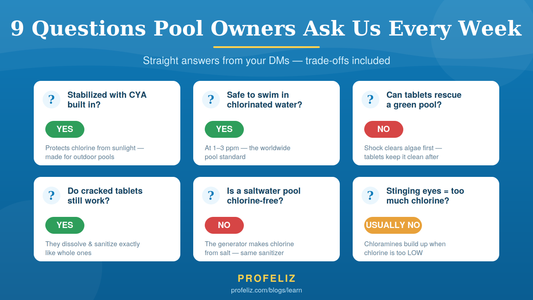
- Cyanuric acid (stabilizer): 30–50 ppm. This "sunscreen for chlorine" protects it from being burned off by UV rays. Without it, sunlight can destroy 90% of your chlorine in just a few hours.
Test strips work fine for weekly checks. A liquid test kit gives more precise readings if your numbers seem off.
3. Top Up Your Sanitizer (2 minutes)
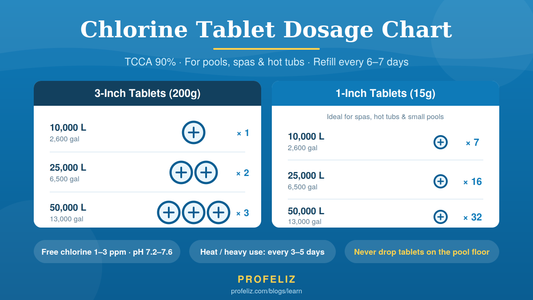
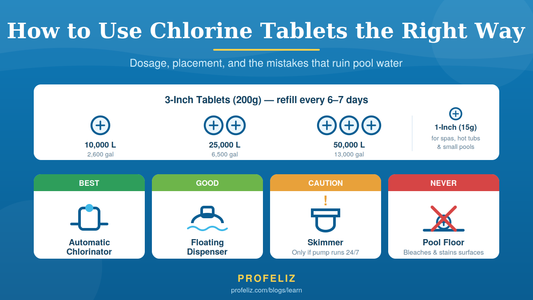
Once you know your chlorine level, adjust accordingly. For most residential pools, slow-dissolving 3-inch stabilized chlorine tablets are the easiest way to maintain a steady 1–3 ppm all week long. Place them in a floating dispenser or an automatic chlorinator — never directly on the pool floor, where they can bleach and damage the surface.
A typical rule of thumb: one 3-inch tablet per 5,000 gallons of water per week. So a 15,000-gallon pool usually needs about 3 tablets weekly. Check your dispenser during this step and refill as needed.
Because tablets dissolve slowly and contain built-in stabilizer, they do double duty — sanitizing your water while protecting chlorine from sunlight. That's why they're the backbone of low-effort pool care.
4. Brush the Walls and Steps (5 minutes)
Algae doesn't start as a visible green cloud. It starts as an invisible biofilm clinging to your walls, steps, and corners — especially in shaded spots with poor circulation.
Give the walls, steps, ladders, and behind ladder rails a quick brush once a week. You're not scrubbing hard; you're just disrupting anything trying to take hold so your chlorine can finish the job. Use a nylon brush for vinyl or fiberglass pools, and a stainless steel brush for plaster or concrete.
5. Vacuum the Floor (10 minutes)
Vacuum any debris that's settled to the bottom. If you have a robotic or suction-side cleaner, just confirm it's running properly and covering the whole pool. If you're vacuuming manually, work in slow, overlapping passes — moving too fast just stirs debris up into the water.
6. Check Circulation and Run Time (2 minutes)
Your pump is the heart of your pool. Each week, quickly confirm:
- The pump runs at least 8 hours a day in summer (enough to turn over all the water once)
- Return jets have strong, steady flow
- The filter pressure gauge reads normal — if it's 8–10 psi above its clean baseline, it's time to backwash (sand/DE filters) or rinse the cartridge
Weak circulation creates "dead zones" where chlorine can't reach — and dead zones are where cloudy water and algae always begin.
7. Check the Water Level (1 minute)
Water should sit at the midpoint of your skimmer opening. Too low, and your pump can suck air and burn out. Too high, and the skimmer can't pull surface debris effectively. Top up with a garden hose if evaporation has taken its toll — in peak summer, pools can lose a quarter inch or more per day.
The Once-a-Month Extras
On top of your weekly routine, add these monthly:
- Shock the pool with a dose of granular chlorine to burn off contaminants that build up from swimmers, rain, and sun — do it at dusk, and more often after parties or storms.
- Test cyanuric acid and calcium hardness, which drift slowly and don't need weekly checks.
- Deep-clean the filter cartridge or backwash thoroughly.
Print-and-Stick Weekly Checklist
- ☐ Skim surface, empty skimmer & pump baskets
- ☐ Test water: chlorine 1–3 ppm, pH 7.2–7.6, alkalinity 80–120 ppm
- ☐ Refill chlorine tablet dispenser (1 tablet per 5,000 gal/week)
- ☐ Brush walls, steps, and corners
- ☐ Vacuum the floor
- ☐ Check pump run time & filter pressure
- ☐ Confirm water level at mid-skimmer
The Bottom Line
Pool care isn't about heroic weekend rescues — it's about small, consistent habits. Thirty minutes a week keeps your water balanced, your chlorine working, and algae permanently uninvited.
The easiest place to start? Make sure your sanitizer never runs out. Profeliz stabilized chlorine tablets dissolve slowly and evenly, keeping your pool protected between weekly check-ins — so the hardest part of your routine is deciding when to swim.
Tags:
Previous
Why Is My Pool Water Cloudy? 7 Causes and How to Fix Each One
Next
How to Use Chlorine Tablets the Right Way (Dosage, Placement, and Mistakes to Avoid)