
9 Questions Pool Owners Ask Us Every Week (Answered Honestly)
We read every DM and comment that comes into Profeliz — and after thousands of conversations with pool owners, the same questions keep coming up. Some are quick facts, some are healthy skepticism, and a few come from folks who clearly know their water chemistry and want straight answers.
So here they are: the nine questions we get asked most, answered the same way we answer them in your DMs — honestly, including the trade-offs.
1. "Are these tablets stabilized or unstabilized?"
Stabilized. Profeliz tablets are trichlor (TCCA 90%) with cyanuric acid (CYA) built in. CYA acts like sunscreen for chlorine — without it, UV rays can destroy most of your chlorine within hours on a sunny day. That's what makes stabilized tablets the right choice for outdoor pools: the chlorine actually survives long enough to do its job.
One honest caveat that we'll expand on below: because every tablet adds a little CYA, you'll want to keep an eye on your CYA level over the season.
2. "Is this organic or inorganic chlorine?"
Trichlor is a stabilized organic chlorine — "organic" here is a chemistry term meaning the chlorine is bonded to a carbon-based compound (the cyanuric acid), not a claim about farming practices. Inorganic chlorines, like cal-hypo (calcium hypochlorite) and liquid chlorine, have no built-in stabilizer — they act fast but burn off fast in sunlight, which is why they're better suited to shock treatments than daily maintenance.
Simple rule: organic/stabilized for everyday tablets, inorganic/unstabilized for shock. The two are teammates, not rivals.
3. "Doesn't CYA build up too high over time?"
Yes — and anyone who tells you otherwise is selling something. With any trichlor tablet (ours included), CYA accumulates gradually because every tablet adds a small amount. Left unmanaged, high CYA eventually makes chlorine sluggish — the dreaded "chlorine lock."
The fix is simple management, not switching products:
- Test CYA regularly and keep it in the 30–50 ppm sweet spot
- If it climbs too high, a partial water change dilutes it back down
- When you shock, use an unstabilized shock (like cal-hypo) so you're not adding even more CYA
Managed this way, tablets stay the easiest sanitizing routine all season.
4. "How many tablets do I actually need? The video showed just one..."
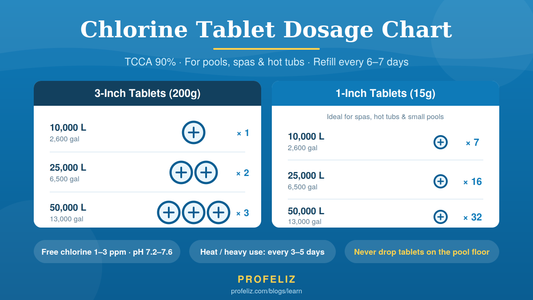
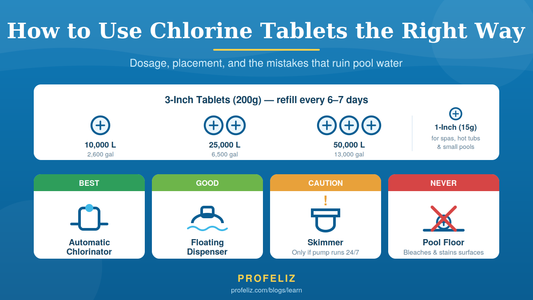
The number depends entirely on your pool's volume — demo videos are just that, demos. The official baseline for our 3-inch (200g) tablets: 1 tablet per 10,000 liters (2,600 gallons), every 6–7 days. Bigger pool, more tablets; hot tub or small pool, consider our 1-inch (15g) size instead.
For the full dosage table (both tablet sizes, plus hot-weather adjustments), see our [Chlorine Tablet Dosage Chart].
5. "Is it safe to swim in? Then why do you handle tablets with gloves?"
Two different situations, two different concentrations.
In the pool: at the proper level of 1–3 ppm free chlorine — the standard used in pools worldwide — swimming is completely safe. That's the entire point of chlorine: making water safe.
In your hand: a solid tablet is concentrated sanitizer, the same way household bleach is concentrated. Gloves are just sensible handling practice for the undissolved product. Once a tablet dissolves into thousands of liters of water, it's diluted to that safe 1–3 ppm.
And the classic follow-up — "but chlorine makes my eyes sting!" — has a counterintuitive answer: stinging eyes and strong "chlorine smell" usually come from chloramines, which build up when chlorine is too low to finish its job. A properly chlorinated pool barely smells at all. If your eyes burn, test your water — you likely need more chlorine, not less.
6. "My pool is green — will tablets fix it?"
Honest answer: no, not on their own. Slow-release tablets are designed for day-to-day maintenance — keeping already-clear water clean. An active algae bloom needs a shock treatment (a fast, high dose of chlorine) plus brushing and continuous filtering to kill and clear the algae. Once the water is clear again, tablets take over and keep it that way.
Full rescue walkthrough here: [How to Clear a Green Pool Fast (Without Draining It)].
7. "Aren't saltwater pools better? No chemicals!"
Here's the thing most people don't realize: a saltwater pool is still a chlorine pool. The salt generator simply produces chlorine from salt automatically — the water sanitizing your pool is chemically the same.
Salt systems are genuinely great for many owners; the trade-offs are upfront cost (several hundred to $1,000+, plus periodic cell replacements) and salt's corrosive effect on some surfaces and fittings. Tablets deliver the same sanitizing with zero equipment investment. Both work — it comes down to your setup and budget.
8. "What about copper or mineral systems?"
Copper and mineral systems do help control algae and some bacteria — but copper alone works slowly and doesn't reliably kill viruses. That's why nearly every mineral system's own manual still calls for a low level of chlorine as backup. Many pool owners happily run both: minerals to suppress algae, a reduced chlorine dose for actual disinfection. Different tools, both useful.
9. "My tablets arrived cracked — are they ruined?"
No — and this is worth knowing before you open a claim anywhere you shop. Chlorine tablets can crack under shipping pressure, but a cracked tablet sanitizes exactly the same as a whole one. It dissolves the same way and releases the same chlorine. The only exception is tablets crushed into powder, which dissolve too fast for slow-release use.
That said, if your Profeliz order arrives damaged, message us with your order number — we stand behind every box and we'll take care of you.
The Pattern Behind All 9 Answers
Notice a theme? Almost every question comes down to the same three fundamentals:
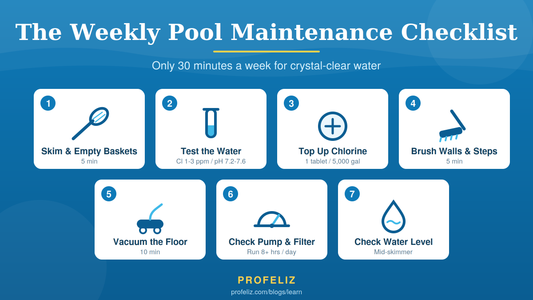
- Test your water — chlorine 1–3 ppm, pH 7.2–7.6, CYA 30–50 ppm
- Tablets maintain; shock rescues — use each for its job
- Concentration is everything — concentrated tablets need careful handling; properly diluted pool water is safe by design
Get those three right, and you've already answered most questions before they come up.
Got a question we didn't cover? Send it to us on [Facebook] or [Instagram] — the questions in this article all started as someone's DM.
Tags: