
How to Use Chlorine Tablets the Right Way (Dosage, Placement, and Mistakes to Avoid)
Chlorine tablets are the easiest way to keep a pool sanitized — drop them in a dispenser, and they quietly protect your water all week. But "easy" doesn't mean foolproof. We regularly hear from pool owners whose water turned cloudy, whose liners developed bleached spots, or whose chlorine readings stayed stubbornly low — and in most cases, the tablets weren't the problem. How they were used was.
Here's everything you need to know to get it right: how tablets work, how many your pool needs, where to put them, and the five mistakes to avoid.
What Chlorine Tablets Actually Do
Profeliz pool tablets are made of TCCA 90% (trichloroisocyanuric acid) — a stabilized, slow-dissolving form of chlorine with about 90% available chlorine, suitable for outdoor and indoor pools, spas, and hot tubs. Two things make them the backbone of low-effort pool care:
- They dissolve slowly. Instead of the spike-and-crash of liquid chlorine, tablets release sanitizer gradually over 6–7 days, holding your free chlorine in the ideal 1.0–3.0 ppm range between weekly check-ins.
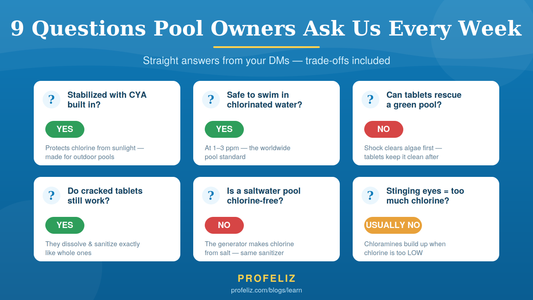
- They're pre-stabilized. Each tablet contains cyanuric acid (CYA), which shields chlorine from being destroyed by sunlight. Unstabilized chlorine can lose 90% of its power to UV rays in just a few hours on a sunny day.
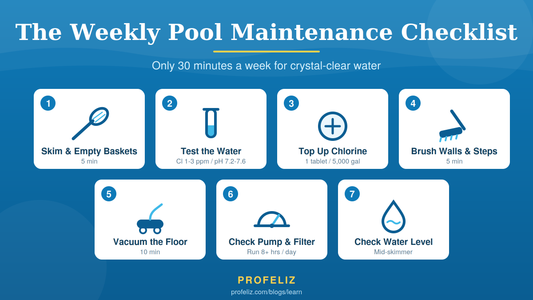
In other words: tablets handle your everyday sanitizing. (For weekly upkeep beyond sanitizing, see our [Weekly Pool Maintenance Checklist].)
How Many Tablets Does Your Pool Need?
Tablets come in two sizes, each with its own job:
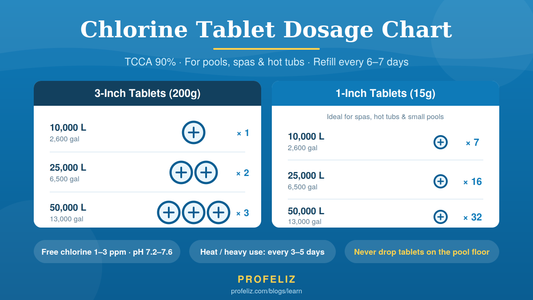
3-inch tablets (200g) are the workhorse for standard pools. Add them every 6–7 days:
| Water volume | 3-inch tablets per refill |
|---|---|
| 10,000 L (2,600 gal) | 1 tablet |
| 25,000 L (6,500 gal) | 2 tablets |
| 50,000 L (13,000 gal) | 3 tablets |
1-inch tablets (15g) are made for spas, hot tubs, and small pools, where a full 3-inch tablet would over-chlorinate — and they give finer control in any pool. Also added every 6–7 days: 7 tablets per 10,000 L, 16 per 25,000 L, 32 per 50,000 L.
Note that dosage doesn't scale linearly — larger water bodies hold chlorine more stably, so they need proportionally fewer tablets per liter. Resist the urge to "round up generously."
Dosage also isn't set-and-forget. During heat waves or heavy swim weekends, chlorine gets consumed faster — shorten your refill cycle to every 3–5 days, guided by your test readings. If free chlorine keeps dipping below 1.0 ppm before the next refill, shorten the interval; if it holds above 3.0 ppm all week, stretch it out.
For volume-calculation formulas, water balance targets, and answers to common dosing questions, see the full guide: [Chlorine Tablet Dosage Chart: Exactly How Many Tablets Your Pool Needs].
Balance Your Water First
Chlorine only works at full strength in balanced water. Test weekly and keep your water in these ranges:
- Free chlorine: 1.0–3.0 ppm
- pH: 7.2–7.6 — when pH drifts high, chlorine loses most of its killing power
- Total alkalinity: 100–120 ppm — buffers your pH so it stays put
- Cyanuric acid: 30–50 ppm — chlorine's sunscreen
If your pH is sitting at 8.0, more than half your chlorine is effectively switched off — no amount of extra tablets fixes that. Balance first, then dose.
Where to Put Chlorine Tablets (Ranked)
Where you place tablets matters as much as how many you use.
Best: An Automatic Chlorinator
An inline or offline chlorinator installs in your plumbing after the filter and heater. Water flows past the tablets, picks up chlorine, and returns to the pool — with an adjustable dial that controls the feed rate. It's the most consistent, most controllable option, and the tablets never touch your pool surface.
Good: A Floating Dispenser
The classic floater is inexpensive and works well for most pools. Load your tablets, adjust the vents to control dissolve speed, and let it drift. Two caveats: tie it away from skimmers (so it doesn't get stuck in one corner) and remove it while people are swimming, then return it afterward.
Use With Caution: The Skimmer Basket
Tablets in the skimmer dissolve fine while the pump runs — moving water carries chlorine into the pool efficiently. The problem starts when the pump shuts off: the tablet keeps dissolving into still water, creating a pocket of highly acidic, super-chlorinated water that then gets pulled through your pump, filter, and heater at startup. Over time, that corrodes equipment. Only use the skimmer method if your pump runs 24/7 — which few residential pools do.
Never: The Pool Floor
Never drop tablets directly into the pool. A tablet sitting on the bottom will bleach vinyl liners, etch plaster, and stain fiberglass — permanent damage concentrated in one spot. It also sanitizes poorly, since all the chlorine pools at the bottom instead of circulating.
5 Common Tablet Mistakes (and How to Avoid Them)
1. Throwing tablets straight into the pool. As above — this is the #1 cause of bleached liner spots. Always use a dispenser or chlorinator.
2. Using tablets to fix a green pool. Tablets are for maintenance, not rescue. They release chlorine far too slowly to kill an active algae bloom. A green pool needs shock — a large, fast dose of granular chlorine. (Full walkthrough here: [How to Clear a Green Pool Fast — Without Draining It].)
3. Ignoring cyanuric acid buildup. Because TCCA tablets add stabilizer with every dose, CYA slowly accumulates over the season. Once CYA climbs well past the 30–50 ppm target, it starts "locking up" your chlorine and making it sluggish — a common cause of persistently [cloudy water]. Test CYA monthly; if it's high, partially drain and refill with fresh water. This is also why you shouldn't oversize your dose "just to be safe."
4. Letting the dispenser run empty. Even 2–3 days with zero sanitizer is enough for algae to gain a foothold in midsummer heat. Make checking the dispenser part of your weekly routine.
5. Storing tablets carelessly. TCCA is a powerful oxidizer. Keep the bucket sealed, in a cool, dry, ventilated space, away from sunlight — and never let tablets contact other pool chemicals, especially cal-hypo shock. Mixing the two can cause fire or toxic gas. Always wash your hands after handling, and keep the bucket out of reach of children and pets.
Quick Reference
- 3-inch (200g): 1 tablet / 10,000 L (2,600 gal) · 2 / 25,000 L · 3 / 50,000 L — every 6–7 days
- 1-inch (15g): for spas, hot tubs & small pools — 7 / 16 / 32 tablets for the same volumes
- Heat or heavy use: refill every 3–5 days instead
- Target free chlorine: 1.0–3.0 ppm, tested weekly
- Best placement: automatic chlorinator > floating dispenser
- Never: on the pool floor, or in the skimmer with an intermittent pump
- Remember: tablets maintain clear water; shock rescues bad water
The Bottom Line
Used correctly, chlorine tablets are the closest thing pool care has to autopilot: steady sanitizer, built-in sun protection, and just a two-minute refill each week. Get the dose right, keep them off the pool floor, and pair them with a weekly test — and cloudy, green water simply never gets a chance.
Profeliz TCCA 90% chlorine tablets come in 3-inch (200g) and 1-inch (15g) sizes — slow-dissolving, stabilized, and suitable for outdoor and indoor pools, spas, and hot tubs.
Tags:
Previous
The Ultimate Weekly Pool Maintenance Checklist (Only 30 Minutes a Week)
Next
Chlorine Tablet Dosage Chart: Exactly How Many Tablets Your Pool Needs (3-Inch & 1-Inch)