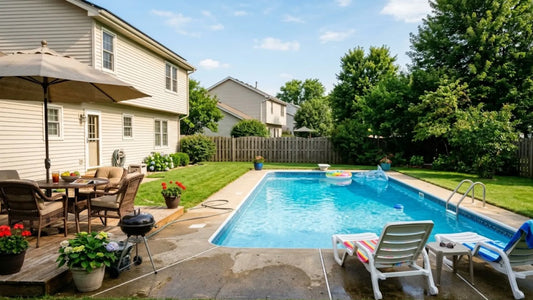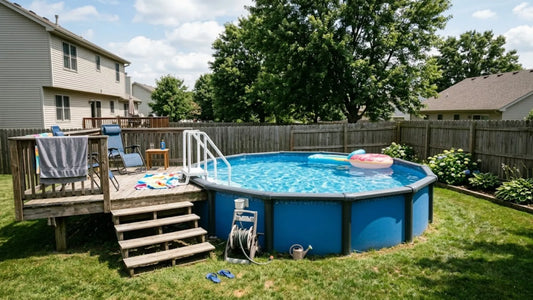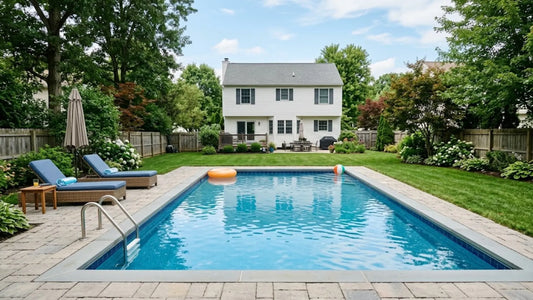

Chlorine Tablet Dosage Chart: Exactly How Many Tablets Your Pool Needs (3-Inch & 1-Inch)
"How many tablets should I add?" is the single most common question we get — and the answer printed in tiny text on a chemical bucket isn't always easy to follow. So here it is, spelled out: the exact dosage for Profeliz TCCA 90% chlorine tablets, in both sizes, for every common pool and spa volume, plus the water balance targets that make every tablet work at full strength.
Bookmark this page. It's the only dosage reference you'll need all season.
Step 1: Know Your Water Volume
Dosage starts with one number: how much water you're treating. If you don't know it, use these quick formulas (measure in feet, get gallons):
- Rectangular pool: Length × Width × Average Depth × 7.5
- Round pool: Diameter × Diameter × Average Depth × 5.9
- Oval pool: Length × Width × Average Depth × 6.7
Average depth = (shallow end + deep end) ÷ 2.
For reference: 10,000 liters ≈ 2,600 gallons · 25,000 liters ≈ 6,500 gallons · 50,000 liters ≈ 13,000 gallons.
Step 2: Balance Your Water First
Chlorine only works properly in balanced water. Before your first dose — and weekly after that — test and adjust to these targets:
| Parameter | Target range | Why it matters |
|---|---|---|
| Free chlorine | 1.0–3.0 ppm | The effective sanitizing range |
| pH | 7.2–7.6 | Comfort for swimmers, maximum chlorine efficiency |
| Total alkalinity | 100–120 ppm | Buffers and stabilizes pH |
| Calcium hardness | 100–200 ppm (home pools) · 200–300 ppm (outdoor pools with heavy rain) | Protects surfaces and equipment |
| Cyanuric acid (CYA) | 30–50 ppm | Shields chlorine from sunlight |
If your pH is sitting at 8.0, more than half of your chlorine's sanitizing power is effectively switched off — no amount of extra tablets fixes that. Balance first, then dose.
Step 3: Dose by the Chart
Profeliz tablets are TCCA 90% (trichloroisocyanuric acid) — slow-dissolving, stabilized chlorine designed for continuous sanitizing over 6–7 days.
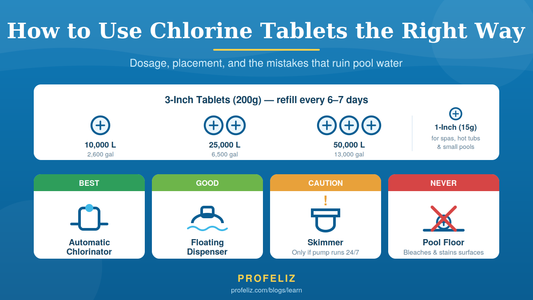
3-Inch Tablets (200g) — for pools
| Water volume | Dosage | Approx. daily chlorine release |
|---|---|---|
| 10,000 L (2,600 gal) | 1 tablet every 6–7 days | ≈ 2.5–3.0 ppm |
| 25,000 L (6,500 gal) | 2 tablets every 6–7 days | ≈ 2.1–2.4 ppm |
| 50,000 L (13,000 gal) | 3 tablets every 6–7 days | ≈ 1.5–1.8 ppm |
Notice the dosage doesn't scale linearly: bigger pools need proportionally fewer tablets per liter, because larger water bodies hold chlorine more stably and lose less to splash-out and surface evaporation per gallon. Don't "round up generously" here — follow the chart, then let your test kit tell you if an adjustment is needed.
1-Inch Tablets (15g) — for spas, hot tubs, and small pools
| Water volume | Dosage | Approx. daily chlorine release |
|---|---|---|
| 10,000 L (2,600 gal) | 7 tablets every 6–7 days | ≈ 1.35–1.58 ppm |
| 25,000 L (6,500 gal) | 16 tablets every 6–7 days | ≈ 1.23–1.44 ppm |
| 50,000 L (13,000 gal) | 32 tablets every 6–7 days | ≈ 1.23–1.44 ppm |
Which size should you use? 3-inch tablets are the workhorse for standard pools — fewer tablets, longer dissolve time, less refilling. 1-inch tablets shine in small water bodies (spas, hot tubs, inflatable and above-ground pools) where a full 3-inch tablet would over-chlorinate, and they give finer control when you need to nudge chlorine up just slightly.
Step 4: Adjust for Real Conditions
The chart assumes normal conditions. Two situations call for a faster cycle:
- Heavy bather load — pool parties, daily swimmers, kids cannonballing all afternoon. Sweat, sunscreen, and organic matter consume chlorine quickly.
- Hot weather — sustained high temperatures and intense sun accelerate chlorine loss, even with CYA protection.
In either case, shorten the interval from every 6–7 days to every 3–5 days, and let your test readings make the final call:
- Free chlorine dipping below 1.0 ppm before the next refill? Shorten the interval (or add one tablet for larger pools).
- Holding above 3.0 ppm all week? Lengthen the interval or reduce the count.
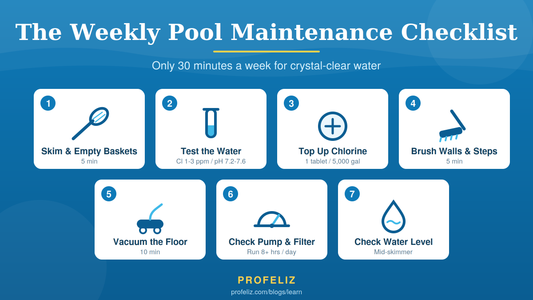
Test at least weekly — twice weekly in peak summer. The chart gets you 90% of the way; your test kit fine-tunes the rest.
Step 5: Place Tablets Correctly
Dosage only works when placement does:
- Use a floating dispenser or an automatic inline chlorinator. Both release chlorine gradually into circulating water, spreading it evenly through the pool.
- Never drop tablets directly onto the pool floor. A tablet resting on the bottom creates a pocket of concentrated acidic chlorine that bleaches vinyl liners, corrodes plaster, and stains fiberglass — permanent, localized damage.
For a full breakdown of placement options (including why the skimmer basket is riskier than it looks), see our guide: How to Use Chlorine Tablets the Right Way.
Quick Answers
Can I cut a 3-inch tablet in half for a small pool?
You can, but 1-inch tablets are the cleaner solution — pre-sized, no chlorine dust, no uneven halves.
My pool is between chart sizes — what do I do?
Start with the lower dosage, test after 2–3 days, and step up if free chlorine falls below 1.0 ppm. It's always easier to add chlorine than to wait out an overdose.
Do tablets replace shock?
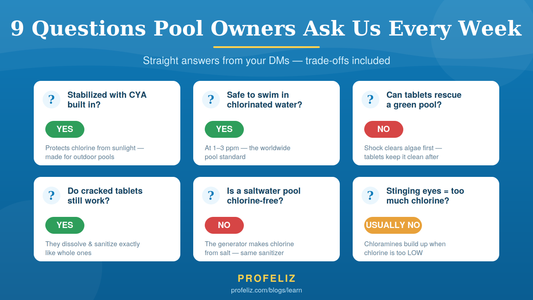
No. Tablets maintain steady sanitizer levels; shock is a periodic high dose that burns off accumulated contaminants. Most pools need both — tablets weekly, shock monthly (more after storms or parties).
Why does my chlorine read low even though the dispenser is full?
Check pH first (high pH cripples chlorine), then CYA (over ~100 ppm causes chlorine lock), then circulation. See: Why Is My Pool Water Cloudy? 7 Causes and How to Fix Each One.
The Bottom Line
Dosing chlorine tablets isn't guesswork — it's three numbers: your water volume, the chart above, and your weekly test reading. Balance the water, follow the chart, adjust to what your test kit says, and your pool holds a steady 1–3 ppm without drama.
Profeliz TCCA 90% chlorine tablets come in both 3-inch (200g) and 1-inch (15g) sizes — slow-dissolving, stabilized, and suitable for outdoor and indoor pools, spas, and hot tubs.
Tags:
Previous
How to Use Chlorine Tablets the Right Way (Dosage, Placement, and Mistakes to Avoid)
Next
9 Questions Pool Owners Ask Us Every Week (Answered Honestly)